
In the age of enhanced creativity, we still have the reins 🧠🤖
🎧Listen to this article:
English
Spanish
⏱️ Estimated reading time: 5 - 7 minutes
Introduction
Imagine and replicate. Describe and materialize. Create. With AI. ✨
Without imagination and creativity, we would have not achieved the technological advances we enjoy today. A question lingers, however. Is technology helping us? Or making us lazy? As many things in these days, it depends.
The author Emily Carroll wrote for the Think Global Forum in March of 2025 that “nearly 90% of college students admit to using for homework. Technically speaking, the work may still be creative. However, current AI creativity is more limited than human creativity—it can’t exceed its inspiration or source materials.”
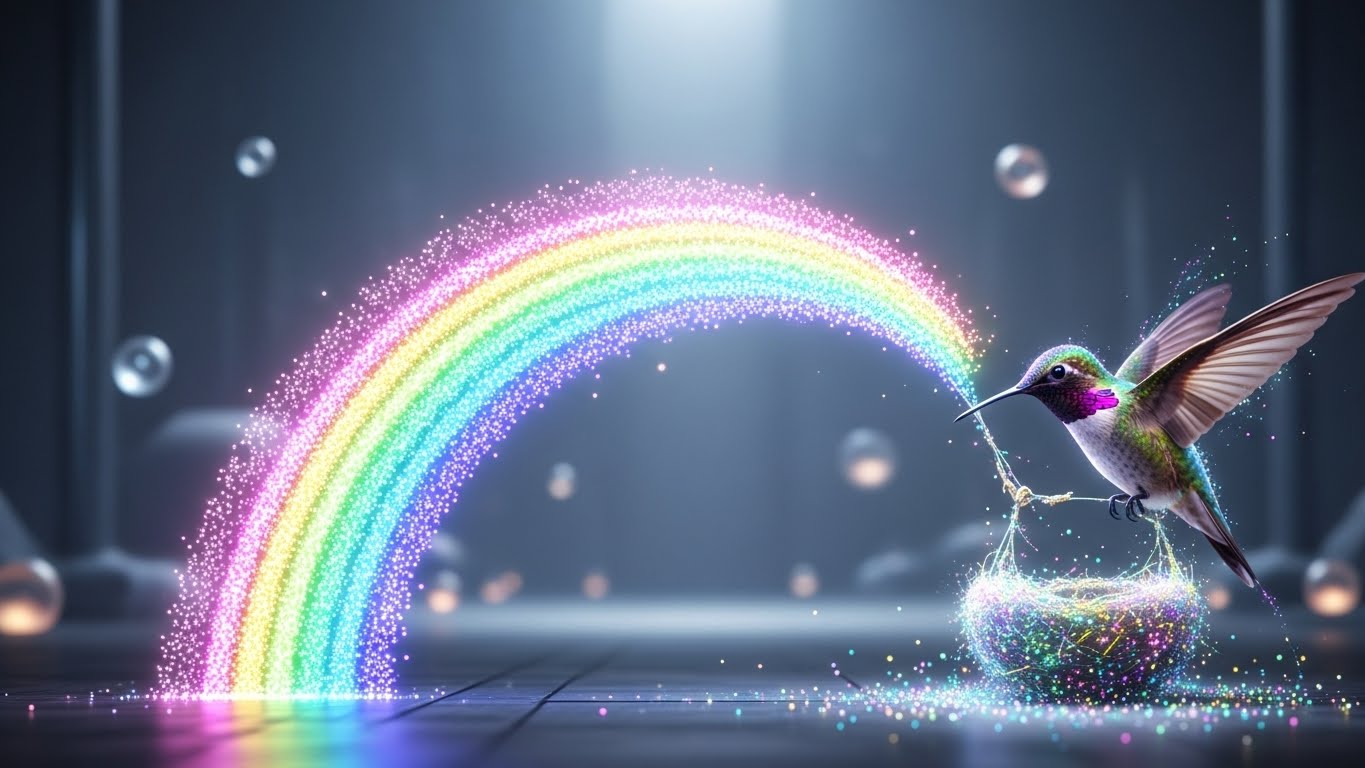
In other words, we can imagine two “real” concepts: a hummingbird building a nest, and a rainbow. If the poet writes “like a hummingbird building her nest on a rainbow…”, a new concept has been created. An abstraction emerges out of reality. 🌈🐦
So, can we really trust that AI is capable of such creative quality? We have seen videos of animals behaving, moving, reacting like humans, but we know it can’t be real since we (still) can tell fake from real at that level. Entertaining, yes, but our mind knows better. It is the realization of our own imperfections and understanding of reality which allows us to comprehend the beauty of a nest on a rainbow and also rejects as fake a soldier human-like animal.
Technology Improving Technology 🚀

Monica Garfield, a computer information systems professor at Bentley University, argues that creativity isn't some ambiguous product of the mind. “It's a measurable quality that can be dampened or amplified using particular tools and scenarios.” Garfield even confirms that dozens of technologies that have become widely available within the last decade or so are boosting creative processes. This aligns with futurist Ray Kurzweil’s law of accelerating returns, which states that the rate of technological progress is not linear, but exponential.
According to Kurzweil, this occurs because each new technological innovation creates more powerful tools that allow for even faster and more significant innovations in the future, a process driven by a feedback loop of innovation and investment.
Like never before, we can today not only perceive the limitations of available technologies, but also tell what is still missing and what we want that is not yet available. For instance, before the smartphone, many of us could not imagine or conceive an app. Today we have apps and functions in our smartphone cameras that were not available to “regular cameras” without investing hundreds of dollars.
Users demanded filters, enhancements, more possibilities. Of course, some may argue that we can all be great photographers with a good camera, but it is the creative eye that sets the difference. It is what we see in our brain that allows the technology to be used the “right (human) way.” All these enhancements now answer the question: what if we could… and we can, better than ever.
Garfield emphasizes that everyone is capable of creativity and that the right tools can elevate that capacity. Music is a clear example. Some AI platforms replicate musical styles and create hybrid melodies. We may enjoy them, but we also recognize the difference between a fusion inspired by jazz or classical music and an original composition by Tchaikovsky or Miles Davis. We ask ourselves: Can AI produced music carry the same depth as a human creation? Do we relate to it with the same emotional weight?
AI creativity is tightly linked to the data that trains it. Even when it simulates originality, it does not yet possess the intuitive, context-rich understanding that humans bring to their creative processes.
Incomplete Algorithms and Video Game Realities 🎮

While the simulation hypothesis predates video games, they have made the theory more accessible and understandable to the public. Just like evolving technologies built on top of others (hello iPhone), the merger of television and video games expanded our universe to the point that theories like “we live in a simulation” are now even tangible.
We can now simulate worlds and create histories where monsters are fought with a combination of traditional and impossible weapons (lightsabers, anyone?) that are getting even better with the help of AI and direct stimulants to the brain like a VR headset.
The threshold between imagined and real is hence blurring. Even quantum physics suggests, like in a simulation or video game, that we “create” reality when we observe it, when our brain detects the particles that build reality.
Think of a video game. When you move the cursor or place the character in a different perspective... does that visible portion of the world exist before the character is pointing in that direction? Or is it created only when the video game character must interact with that “reality”?
AI may be accelerating our access to alternative realities, but AI is not totally independent. Not yet.
The good news is that we still have control. We can turn the process on and off, like an app, a phone or a video game. It is still our idea translated in the prompts we feed to the technology we use.
Yes, it also depends on how artistic or creative we can be. The way each brain processes information makes a portion of the population incredibly imaginative with the capacity to translate or bring to reality what they can imagine. Others — like me — may be creative, imaginative, but incapable of bringing those ideas to this plane.
Take the probably apocryphal quote from Michelangelo: “I saw the angel in the marble and carved until I set him free.” It seems the new angels are carved in zeros and ones, but we, as humans, need to see them first. For now.
Reflection Questions 💭
Am I using AI to expand my creativity or to avoid effort? ✍️🤔
Do I still feel the difference between something crafted through lived experience and something assembled from patterns? 🌱📊
How do I respond emotionally to the technology I use each day? 💡💓
How can I support others so they do not feel overwhelmed by rapidly evolving tools? 🤝🌐
Conclusion 🌟
AI, algorithms and virtual worlds are not replacing our humanity. They are mirrors and amplifiers. They reflect what we feed them and amplify either our depth or our avoidance.
At Link Foundation, we believe technology should enhance human imagination, not replace it. Through our programs, we invite our community to explore AI, virtual reality and creative tools without losing their center, their stories or their values.
Verified Sources
Carroll, Emily. "Friends or Foes - The Relationship Between Creativity and Technology in the Age of AI." Think Global Forum, 20 March 2024. Available at: https://www.thinkglobalforum.org/tgf-blog/friends-or-foes-creativity-and-technology
Garfield, Monica. "How Technology Is Boosting Your Creativity." Bentley University. Available at: https://www.bentley.edu/news/how-technology-boosting-your-creativity
Kurzweil, Ray. "The Law of Accelerating Returns." Available at: https://www.kurzweilai.net/the-law-of-accelerating-returns and summary at: https://en.wikipedia.org/wiki/The_Law_of_Accelerating_Returns
Virtual reality and vestibular rehabilitation. Scientific Reports and related clinical research. Key examples: https://www.nature.com/articles/s41598-021-97370-9 and https://pubmed.ncbi.nlm.nih.gov/34497323/
Bostrom, Nick. "Are You Living in a Computer Simulation?" and related work on the simulation hypothesis. Available at: https://www.simulation-argument.com/simulation.html and summary at: https://en.wikipedia.org/wiki/Simulation_hypothesis
Michelangelo quote "I saw the angel in the marble and carved until I set him free" as popularly attributed. Collected at:https://www.brainyquote.com/quotes/michelangelo_161309
🧭 Ready to go deeper?
Explore how identity and consciousness are being reshaped in the age of AI in this article:
Human Identity vs. Machines: Redefining the Self in a World with Non‑Human Intelligences