

Metacognition and Authenticity: How to Guide Technology from the Real Self
🎧Listen to this article:
English
Spanish
AI can help us move faster, but it should not decide who we become. Metacognition helps us return to purpose, observe our choices, and use technology from a more authentic self.(Frazier et al., 2021; American Psychological Association [APA], 2024)
Returning to the Real Self
Today, we live surrounded by stimuli, recommendations, and automation. That abundance can make it easy to confuse convenience with direction and speed with meaning (Joseph et al., 2025).
From a psychological perspective, this matters because human behavior is shaped not only by external impulses, but also by how we interpret, regulate, and choose our actions (Frazier et al., 2021).
That is why disconnecting in order to reconnect is not an anti-technology slogan. It is an invitation to pause the noise so we can hear what comes from our real self and what comes from inertia, comparison, or the fear of falling behind (Stolterman & Escobar, 2016).
When that inner center weakens, technology stops being an instrument and starts shaping habits, attention, and preferences by default (Joseph et al., 2025).
Metacognition as Practice

Metacognition is the ability to observe our own thinking, evaluate how we make decisions, and correct our course when necessary. In psychology, it is not treated as an abstract idea, but as a form of self-regulation that supports learning, decision-making, and identity development (Frazier et al., 2021).
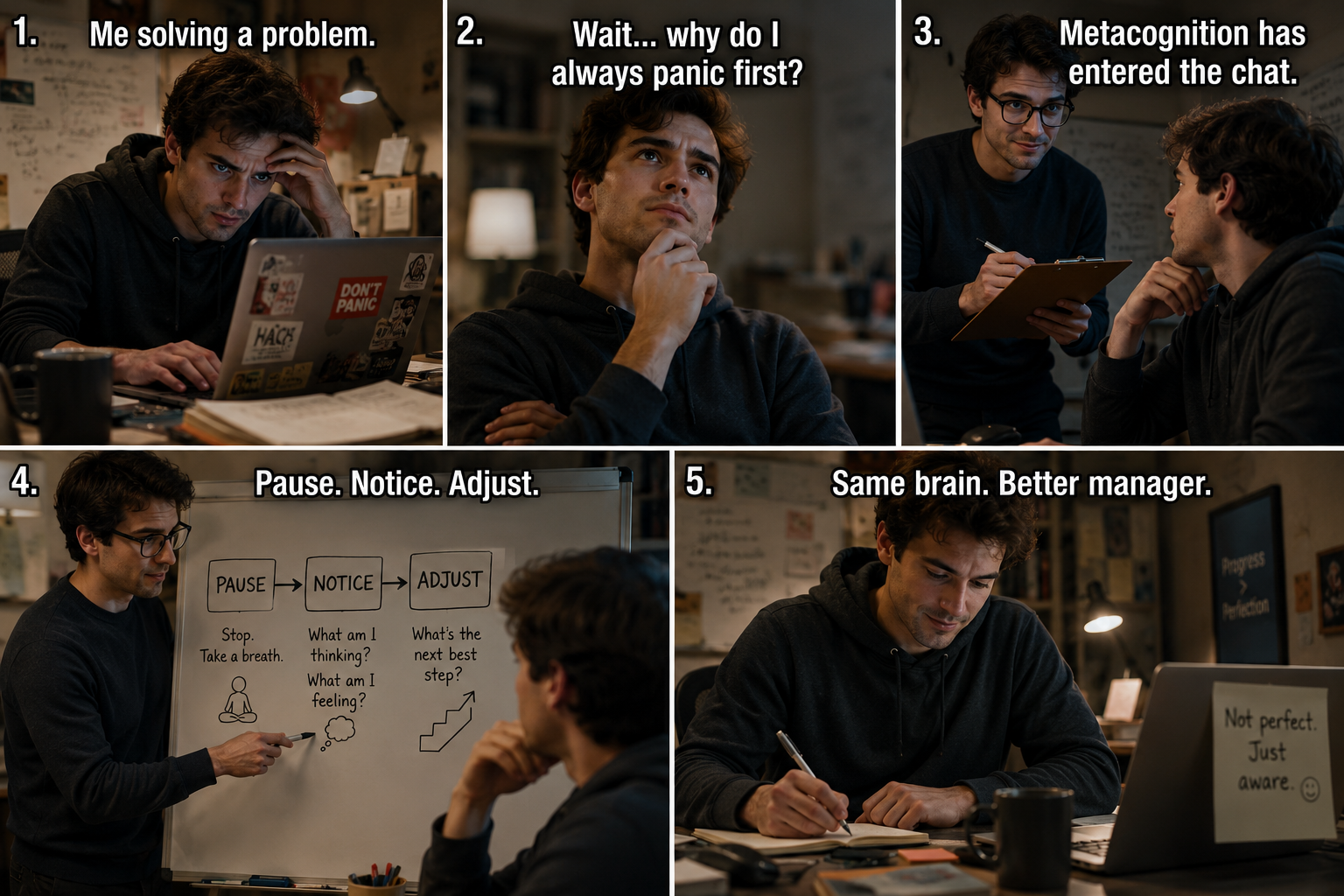
Training metacognition means asking questions before acting: Do I truly want this, or do I want it because I saw it? Does this move me closer to what I want to build, or does it simply keep me occupied? Am I using this tool, or is it defining my behavior? (Frazier et al., 2021; Winne, 1995).
It is an intimate practice, but also a political one, because it restores agency in the face of systems designed to capture attention and guide behavior (Joseph et al., 2025).
Technology can support that process, but it cannot replace it. If we do not train the ability to look at ourselves honestly, we end up handing over our judgment to whatever responds fastest (APA, 2024).
And in doing so, we lose something fundamental: the ability to choose from a conscious identity rather than from an automatic reaction (Frazier et al., 2021; Stolterman & Escobar, 2016).
A Daily Practice
We can strengthen this skill through simple but consistent actions: pausing before opening an app, writing down what we are truly looking for, noticing which emotion is driving us, and closing the loop by asking whether that action serves our purpose (Frazier et al., 2021).
It is not about perfection; it is about presence. Metacognition grows when we stop living on autopilot and start observing the relationship between intention, emotion, and behavior (Frazier et al., 2021; Hollowell et al., 2026).
Purpose Before Tools
One of the most important ideas in this conversation is that purpose must come before technology. First, we need to ask what we want to achieve from our real self, and only then decide which tool can help us move in that direction (Stolterman & Escobar, 2016).
When we reverse that order, technology stops being an ally and becomes an invisible framework that begins to define what we value (Joseph et al., 2025).
This point is crucial because many platforms are designed to suggest, summarize, and predict. That can be useful, but it can also narrow our vision if we let the system organize our preferences too early (Joseph et al., 2025).
Human agency does not mean rejecting the digital world. It means preserving the ability to say, “This only serves me if it aligns with what I truly want to build” (Stolterman & Escobar, 2016; APA, 2024).
From that perspective, technology does not disappear; it changes place. It goes from being a force that pulls us around to becoming a tool we choose with intention (APA, 2024).
That shift may seem small, but psychologically it is enormous, because it protects autonomy and returns to the subject their role as the author of their own life (Frazier et al., 2021).
Why Imperfection Feels Human
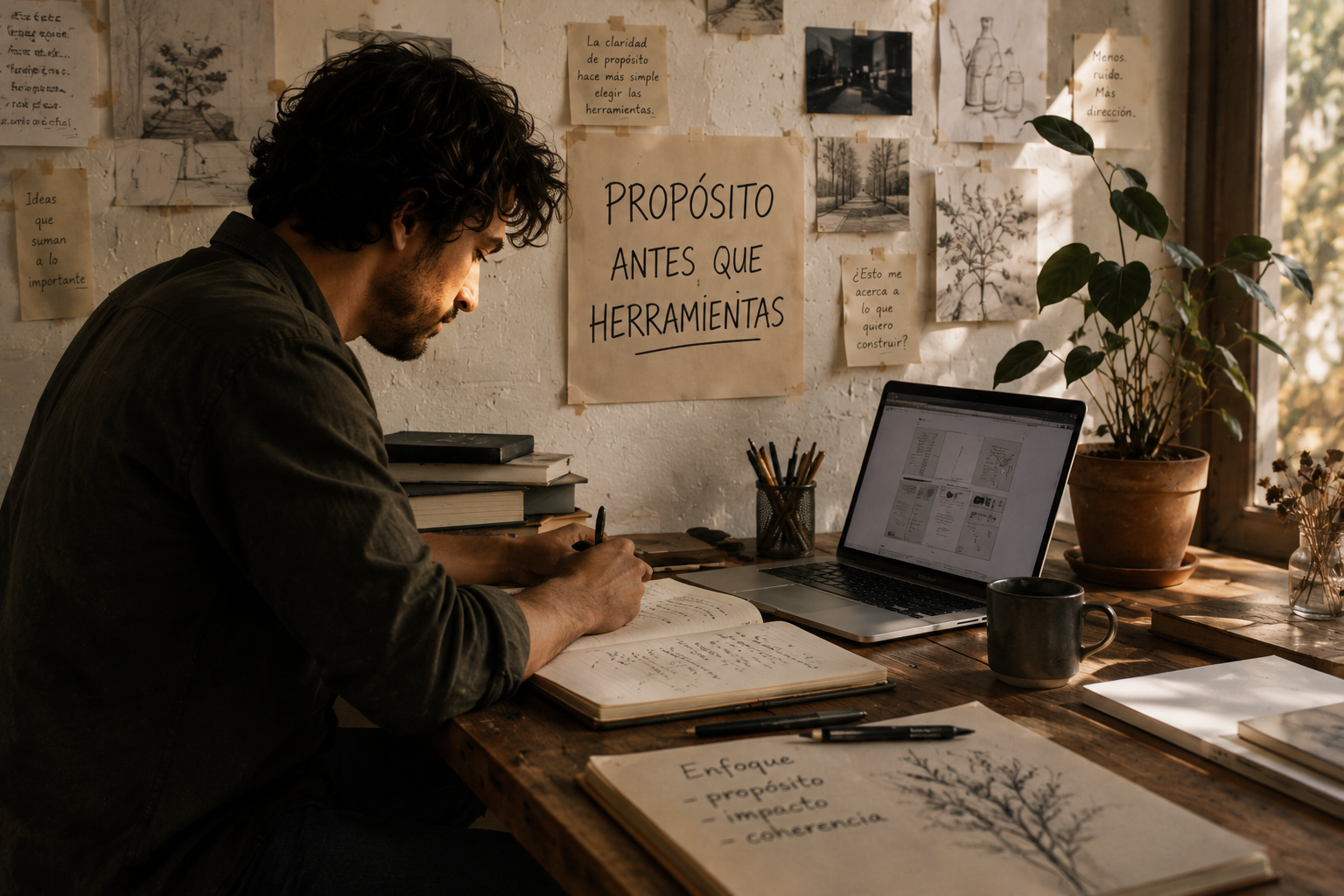
It is no coincidence that imperfection, craft, and humanity are so valued today. In a culture saturated with automation, the traces of process matter more and more than the flawless appearance of the result (Sustainability Directory, 2025; We and the Color, 2025).
The irregular, the tactile, and the unoptimized feel more human because they reflect presence, intention, and the reality of the process (Stolterman & Escobar, 2016; LinkedIn, 2026).
In design, art, and communication, imperfection is no longer seen as failure, but as a sign of authenticity. A human stroke may look less polished, but that is exactly why it can feel more true (Sustainability Directory, 2025; LinkedIn, 2026).
This cultural shift reflects a deeper emotional need: to feel that behind a work there is a body, a story, and an intention, not just an efficient pattern-combination (ScienceDirect, 2025).
From a psychological standpoint, this trend also reflects collective fatigue. When everything feels optimized, people begin searching for something that does not only work, but also moves them (We and the Color, 2025; Sustainability Directory, 2025).
Humanity becomes valuable again because it is not fully predictable, because it tolerates ambiguity, and because it creates the conditions in which individuality and authenticity can grow (Hollowell et al., 2026).
The Beauty of the Unfinished
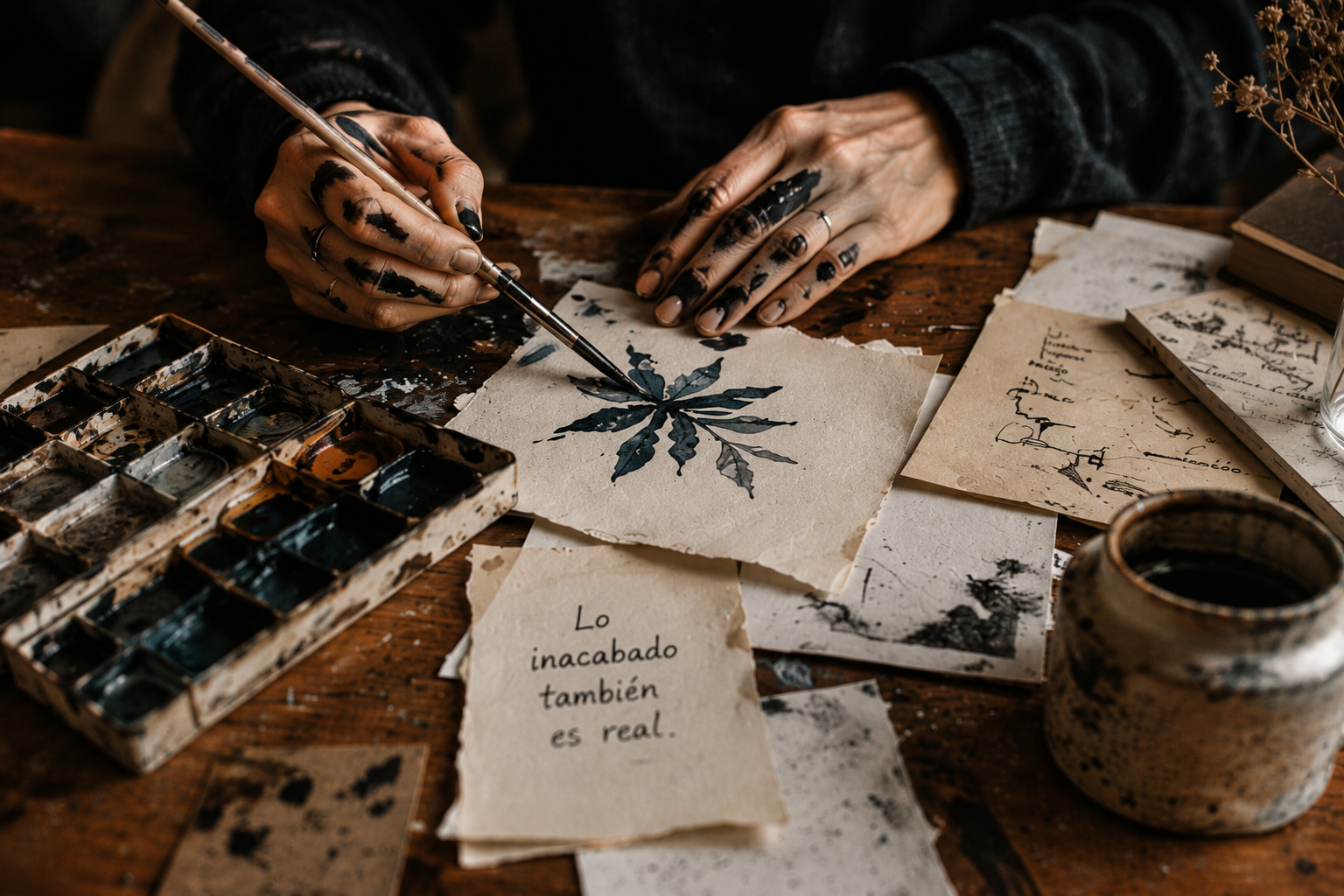
Imperfection reminds us that living is not about producing nonstop, but about sustaining meaning. In an era when machines can generate faster, the human gesture gains power precisely because it reveals limits, choices, and sensitivity (LinkedIn, 2026; We and the Color, 2025).
For that reason, this trend is not decorative nostalgia. It is a cultural response to the need to recover truth, pause, and contact with what is real (Sustainability Directory, 2025; ScienceDirect, 2025).
Byung-Chul Han’s theory of Non-Things helps explain why this return feels so emotionally charged.
Han is a South Korean-born philosopher and cultural theorist who studied metallurgy before moving to Germany to study philosophy, German literature, and Catholic theology; he later taught at the University of Basel and the Berlin University of the Arts.
In Non-Things: Upheaval in the Lifeworld, he argues that the digital order “deobjectifies” the world by turning it into information, weakening our bond with physical objects that once gave continuity, memory, and symbolic depth to everyday life. When objects lose that weight, nostalgia changes too: it becomes less about the past itself and more about recovering tangible forms of connection in the present.
That is part of why people return to vinyl records, print their photographs, and value film development in a lab. These practices are not only retro gestures; they are ways of restoring touch, ritual, and meaning, while also opening space for a new and emerging creative economy built around material experience, craftsmanship, and emotionally resonant objects.
Key Ideas
Metacognition is a skill that must be trained in order to observe, regulate, and direct one’s own behavior.
Authentic purpose must come before the tool.
Disconnecting can also be an act of autonomy and clarity.
The imperfect and the human have become meaningful again because they express truth, presence, and authenticity.
External Influence vs. Inner Direction
Conclusion
The big question of this era is not only how to use AI better. It is how to prevent the outside world from defining our purpose.
Metacognition helps us return to center, review our motivations, and decide from a more authentic self.
Disconnecting in order to reconnect means exactly that: taking a pause to listen to what we truly want, and then using technology as a tool in service of that direction.
If we do not train that capacity, we risk living guided by systems that predict our behavior better than we observe it ourselves.
Maybe that is why imperfect and human-made things are becoming meaningful again. In the middle of growing automation, people are looking for signs of real life, intention, and authenticity.
And perhaps that is the most important task of all: to keep choosing from who we are, not from who the environment wants us to be.
Continue Reading
At Link Foundation, we believe technology should expand human possibility, not replace human purpose.
Take a moment today to pause before using a tool, app, or platform. Ask yourself: is this helping me move closer to what I truly want to build?
This same question also opens a wider conversation about work, data, and the future of human participation in a world shaped by AI.
Continue reading: The Human-Machine Economy: Smart Data... Better Jobs?
That reflection continues this article’s central idea from another angle: technology can either pull us into automatic systems, or it can become a tool we guide with intention. The difference depends on whether we preserve human judgment, purpose, and agency at the center.
References
American Psychological Association. (2024, November 20).Artificial intelligence in mental health care.https://www.apa.org/practice/artificial-intelligence-mental-health-care
Frazier, P. A., et al. (2021).The MAPS model of self-regulation: Integrating metacognition, possible selves, and agency.Personality and Social Psychology Review.https://pmc.ncbi.nlm.nih.gov/articles/PMC7785474/
Fundación Princesa de Asturias. (2025).Byung-Chul Han 2025 Princess of Asturias Award for Communication and Humanities.https://www.fpa.es/en/princess-of-asturias-awards/laureates/2025-byung-chul-han/?texto=trayectoria
Han, B.-C. (2022).Non-things: Upheaval in the lifeworld. Polity.https://philpapers.org/rec/HANNUI-2
Joseph, J., et al. (2025).The algorithmic self: How AI is reshaping human identity, introspection, and self-awareness.Frontiers in Psychology.https://www.frontiersin.org/journals/psychology/articles/10.3389/fpsyg.2025.1645795/full
Recording Industry Association of America. (2026, March 16).U.S. recorded music annual revenue achieves new high of $11.5 billion in 2025.https://www.riaa.com/riaa-reports-us-recorded-music-annual-revenue-achieves-new-high-of-11-5-billion-in-2025/
Shanghai Literary Review. (2023, September 29).Byung-Chul Han’s "Non-things" (Review).https://www.shanghailiterary.com/tslr-online-collection/2023/9/30/review-byung-chul-han-non-things
Verso Books. (n.d.).Byung-Chul Han.https://www.versobooks.com/blogs/authors/han-byung-chul
We and the Color. (2025, December 28).Why the biggest design trend of 2026 is human imperfection.https://weandthecolor.com/why-the-biggest-design-trend-of-2026-is-human-imperfection/207545
Butler, D. L., & Winne, P. H. (1995).Feedback and self-regulated learning: A theoretical synthesis.Review of Educational Research.https://www.jstor.org/stable/1170684